
What Seoul Incheon's Rise to the World's Busiest International Airport Means for Airport Advertising
Updated: 4 days ago
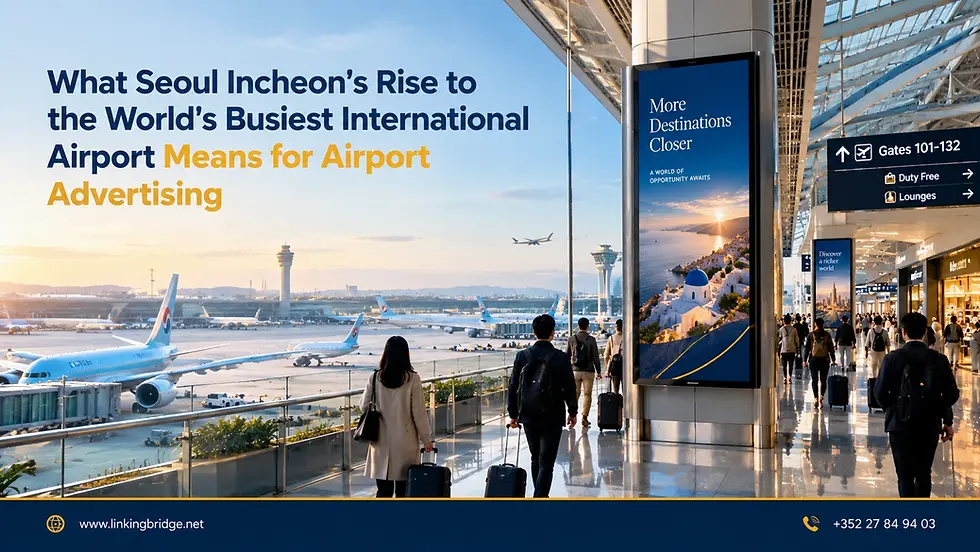
Seoul’s Incheon International Airport became the world’s busiest airport for international passengers in the first half of 2026, the first time it has topped the ranking since opening in 2001. According to preliminary Airports Council International (ACI) figures announced by Incheon International Airport Corporation (IIAC), Incheon handled 38.39 million international passengers between January and June, narrowly ahead of London Heathrow (37.79 million) and Singapore Changi (34.53 million).
For brands, the ranking raises a practical question for airport advertising: what does a larger flow of international passengers actually mean for airport media? The answer depends less on the headline number than on who is passing through, where they spend time and how a campaign can reach them.
1. Why Incheon's International Growth Matters
Incheon is South Korea’s principal international gateway, with 101 airlines serving 183 cities in 53 countries. International passenger numbers rose 6.3% on the same period last year.
According to IIAC, part of the increase reflects travel demand that shifted away from Middle Eastern transit hubs amid regional disruption. Growth in inbound tourism, led by visitors from China and Japan, also contributed.
That context matters for planning. The ranking is based on preliminary data, with official annual figures expected early next year, and part of the shift reflects circumstances beyond Incheon itself. For advertisers, it is a reason to look closely at the airport, not a guarantee that today’s audience mix will last.
2. Passenger Volume Creates a Wider Brand Opportunity
Incheon’s international traffic gives advertisers a broad mix of travellers, but the value depends on who they are and where a campaign can reach them. Two groups stand out in the first-half figures.
Connecting passengers. Incheon handled 4.24 million transfer passengers, up 18.1% year on year. Transfer traffic on European routes rose 63.2%, though from a small base of about 213,500 passengers, according to China Daily. Connecting travellers often have time between flights, which makes dwell time a key planning question.
Read our article on “What Passenger Dwell Time Means for Airport Advertising at Dubai International Airport”
Inbound visitors. Foreign travellers made up 39.3% of Incheon’s passengers in the first half and a record 44.4% in the second quarter. That is relevant to tourism, retail and hospitality brands that want to reach people arriving in South Korea.
Airport-wide totals are not the number of people who will see an advertisement. Exposure depends on the locations selected, the media format, passenger movement and available delivery data. An airport advertising company should assess available inventory against the campaign’s audience and objective, so potential reach is judged on relevance rather than headline traffic.

3. Matching Audiences to Locations at Incheon
Different passengers meet advertising in different places. Arrival areas suit brands speaking to visitors entering South Korea. Departure and retail areas may suit outbound travellers and shopping-related messages, while gate areas and transfer routes reach connecting passengers who may have time to spare. Prominent digital displays can support broad awareness, while placements near retail areas may suit product or promotion-led messages.
Language matters too. International audiences speak different languages and have different expectations, so clear visuals, concise messaging and appropriate language choices help a campaign work across markets. Brands should not assume all international passengers share the same interests or spending habits, and route data and verified audience information should guide the plan.
This is where airport marketing services can add value: connecting the brief with available inventory and passenger touchpoints, rather than treating the airport as one large advertising surface.
4. Digital Media Can Support More Flexible Campaigns
Digital out-of-home advertising can give brands greater flexibility in how they deliver messages across airport environments. Depending on the media network, campaigns may support scheduled creative, updates by location and different messages for particular periods or marketing objectives.
At an international gateway such as Incheon, these options may be relevant to tourism campaigns, international product launches and brands coordinating activity across several markets. For example, a campaign could use different creative for a destination promotion and a broader brand-awareness message, provided the selected inventory supports those placements and scheduling requirements.
Before planning a digital airport campaign, advertisers should confirm which screens are available, where they are positioned and whether the media provider supports scheduled creative, campaign updates or programmatic buying. It is also worth asking what delivery reports, audience estimates and measurement information will be supplied.
These capabilities should be verified rather than assumed. Not every digital display supports audience-based targeting, automated buying or real-time creative changes, and the available options depend on the specific network and commercial arrangements.
For brands considering Incheon, the priority is to match the capabilities of the available media inventory with the campaign objective. Digital flexibility is most useful when it helps deliver a clearer, more relevant message to the intended audience.
Read our article on “How Istanbul Airport Is Moving Toward Programmatic DOOH”

5. Four Questions to Ask Before Planning an Incheon Campaign
Which travellers are you trying to reach? Inbound visitors, who made up 39.3% of first-half passengers, and connecting passengers, at 4.24 million transfers, have different needs from outbound travellers. Define the audience before choosing a location.
Where do those travellers spend time? Connecting passengers may have time between flights, while arriving visitors are focused on entering the country. Match the placement and message to the moment.
How current is the audience data? The ranking is preliminary and partly shaped by circumstances elsewhere, so ask for up-to-date passenger and route information rather than relying on the headline figure.
What will be reported? Agree in advance what delivery information, placement details and audience estimates will be available after the campaign.
6. What Incheon’s Growth Means for Airport Advertising
Incheon topped the world for international passengers in the first half of 2026, handling 38.39 million on preliminary ACI data, with official annual figures due early next year.
For advertisers, the opportunity is not to associate a campaign with a high-ranking airport. It is to work out whether Incheon’s mix of connecting passengers, inbound visitors and routes matches the people a brand wants to reach.
A sound airport media plan starts with the audience, then looks at locations, formats, timing and reporting. Treat the ranking as a reason to look closely at Incheon, not as proof of campaign performance.
Frequently Asked Questions
Why did Incheon become the world’s busiest airport for international passengers in the first half of 2026?
Incheon handled 38.39 million international passengers between January and June, ahead of Heathrow and Changi on preliminary ACI data. IIAC attributes part of the rise to growth in transfer passengers, including demand that shifted away from Middle Eastern transit hubs, alongside record inbound visitors from China and Japan.
Does higher passenger traffic guarantee better airport advertising results?
No. Passenger volume indicates the scale of the airport, but campaign results depend on placement, audience relevance, creative quality, delivery and measurement.
Which brands could consider advertising at Incheon Airport?
Depending on their target audiences and available inventory, tourism, hospitality, retail, luxury, technology and consumer brands may find the airport relevant to their marketing objectives.
What should advertisers assess before planning a campaign?
Advertisers should review passenger and route context, available media formats, placement visibility, creative requirements, campaign timing and the reporting offered by the media provider.
Is Incheon’s ranking final?
No. It is based on preliminary ACI statistics for the first half of 2026, and official annual figures are expected early next year.
What makes Incheon relevant to international airport advertising?
Incheon connects South Korea with international markets and serves both inbound visitors and connecting passengers. Its relevance to an advertising campaign depends on the target audience, available media placements, passenger routes and the campaign’s objectives.
Considering Airport Media for Travellers Through Incheon?
Tell us whether you want to reach inbound visitors, connecting passengers or outbound travellers, and we’ll help you work out which airport media options and reporting to look for. Contact our team to discuss your campaign.


Comments